Summary
Anyverse Dynamics recently released and open-sourced MWA™-Phoenix, a fully pretrained 7B-parameter latent-space world-…

Anyverse Dynamics recently released and open-sourced MWA™-Phoenix, a fully pretrained 7B-parameter latent-space world-model foundation that runs at the edge. According to the company's published results, the model ranked first on six simulation and real-robot evaluations, including LIBERO-Plus, where it achieved an overall success rate of 94.63%, LIBERO-Pro, and the RoboDojo real-robot leaderboard.
Every real-robot manipulation task in this release used Xense tactile sensors as its source of tactile input. In this system, real contact information enters action learning directly and is also used to predict tactile feedback after an action.
For Xense, this is a practical application of its long-term work on tactile sensing and data quality. The model's use of touch to understand and perform manipulation brings together the two companies' technical strengths.
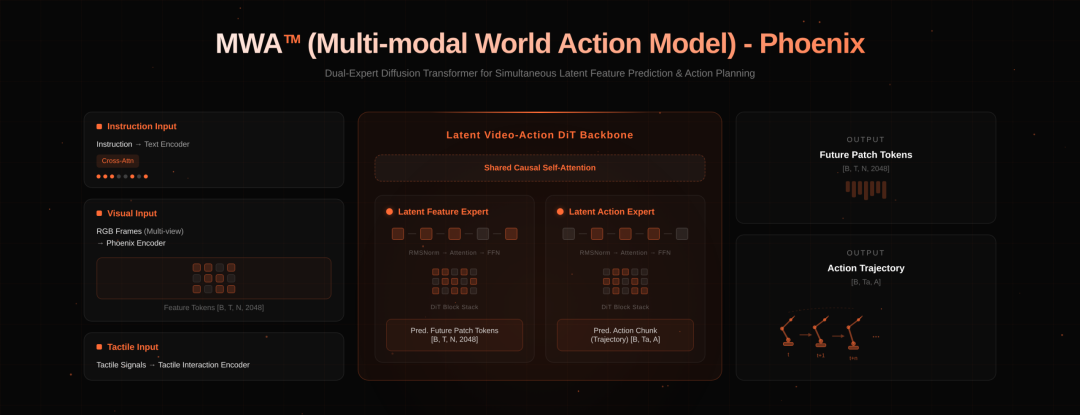
Image credit: Anyverse Dynamics
Tactile Data Directly Informs Action Learning
Xense has long focused on contact information during manipulation. When tactile details are matched to movement, a model can learn from demonstrations how an operation is carried out.
In Anyverse Dynamics' research, Phoenix-ILA encodes synchronized motion and tactile sequences into a shared latent interaction space. The model jointly learns movement, local tactile deformation, and force-related signals, preserving their timing through joint reconstruction. As a peeler moves along a cucumber, for example, the contact between blade and surface is recorded. During plate wiping, tool motion and changes in contact together form a manipulation example.
According to ablation results published by Anyverse Dynamics, adding Phoenix-ILA increased cucumber-peeling success from 20% to 40% and plate-wiping success from 75% to 90%. For tasks requiring continuous contact with a surface, real contact-process data can directly inform action learning.
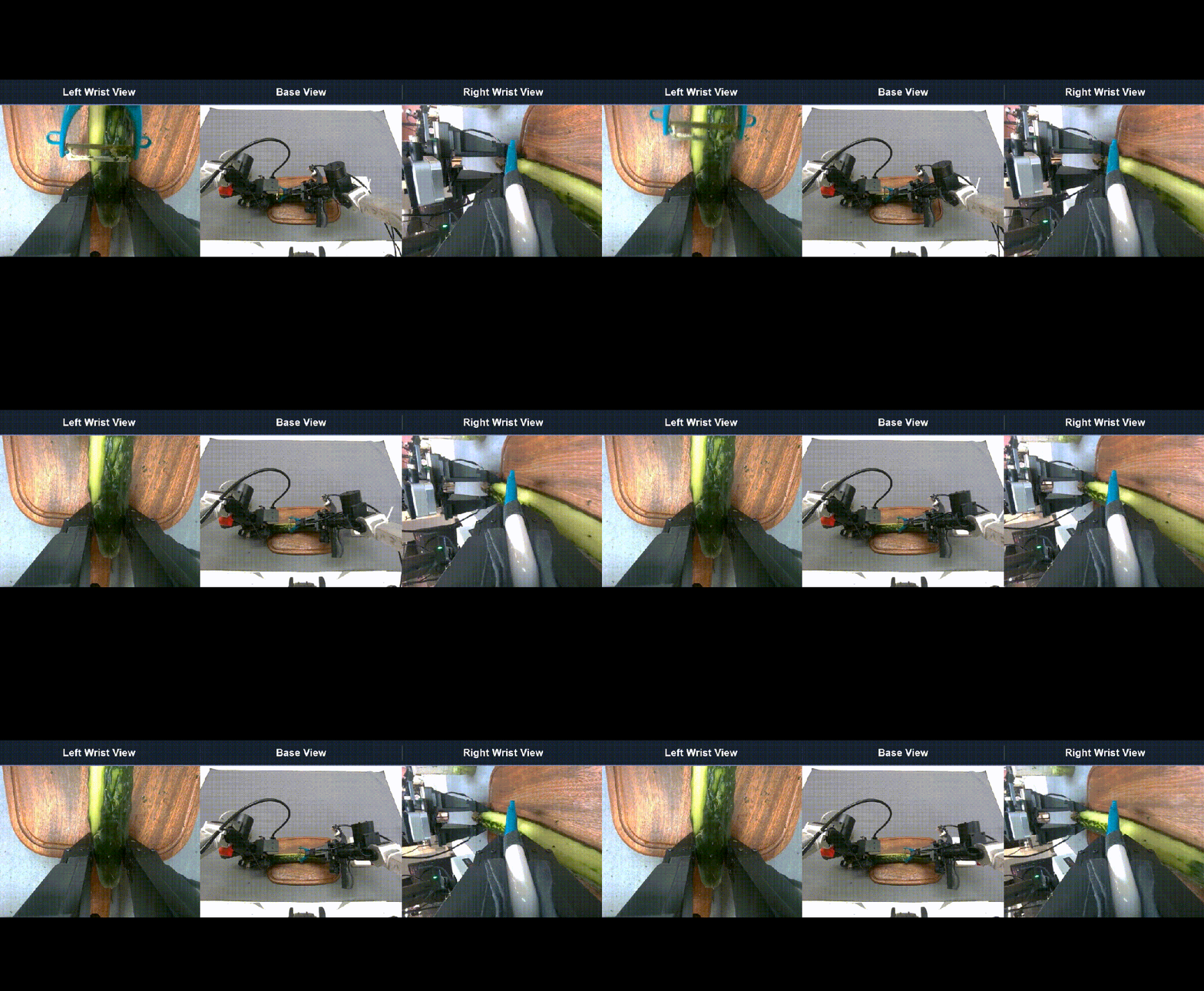

Cucumber peeling and plate wiping demonstrations
Video credit: Anyverse Dynamics
How a World Model Predicts Tactile Feedback
Tactile data also supports policy training before deployment, in addition to action representation.
Phoenix-PhysCanvas, developed by Anyverse Dynamics, is an action-conditioned visual-tactile world model. After a policy proposes an action, it predicts the corresponding visual and tactile feedback, providing observations for subsequent operations and supporting GRPO reinforcement-learning post-training.
Training takes place in an interactive simulation environment, then results are tested on real robots. Anyverse Dynamics first performs supervised fine-tuning on task demonstrations and then optimizes the policy in Phoenix-PhysCanvas. Average real-robot success rose from 58.33% to 75.00% on a test-tube task and from 80.00% to 86.67% on a block task—gains of 16.67 and 6.67 percentage points, respectively.
These results reflect the combined benefits of a visual-tactile world model and reinforcement-learning post-training. For tactile research, a notable development is the extended learning objective: beyond using current contact information, the model must predict the feedback that may follow an action.
Predicting tactile feedback also depends on real examples. The model must learn how actions correspond to changes in contact, and the accuracy of that relationship ultimately depends on the quality of tactile data.
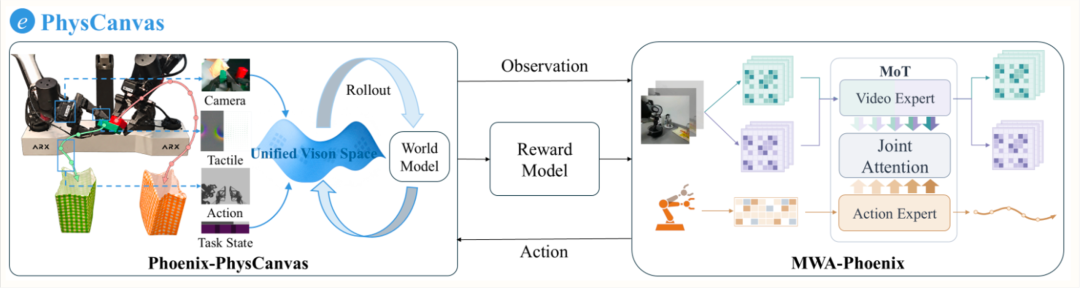
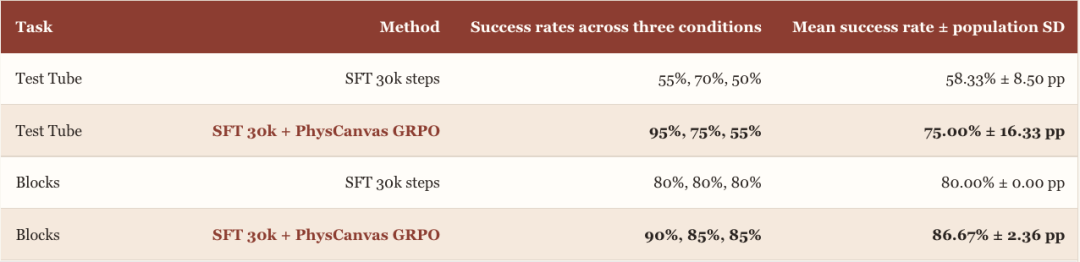
Phoenix-PhysCanvas reinforcement-learning framework and results for the test-tube and block tasks
Image credit: Anyverse Dynamics' MWA™-Phoenix technical report
Tactile Data Standards Behind the Real-Robot Tasks
All real-robot demonstrations released by Anyverse Dynamics used Xense photonic tactile sensors to capture tactile signals. The tasks include fine manipulation that requires continuous detection of contact changes, such as twisting bottle caps, peeling, and wiping. They also include longer tasks such as putting items in a pencil case, making a sandwich, and preparing coffee. Xense sensing captures real contact information across these varied tasks and stages.
Model training often focuses on whether a tactile modality has been added, while overlooking another question: can the tactile signals collected actually serve as useful training examples? In practice, inter-unit consistency, spatial and temporal consistency, and physical consistency in tactile data are often underestimated, even though they determine whether data can be reused at scale. Xense has designed its sensors and embodied data system around these requirements.
Inter-unit consistency and repeated-contact stability determine whether data collected on multiple robots can be pooled for training. Embodied data collection typically uses several devices in parallel and involves frequent repeated contact. If sensors respond differently or an individual device drifts over time, pooled data becomes noisy.
Xense uses inter-unit consistency and repeated-contact stability tests in sensor R&D and production to keep outputs comparable across devices under the same conditions and stable after repeated contact.
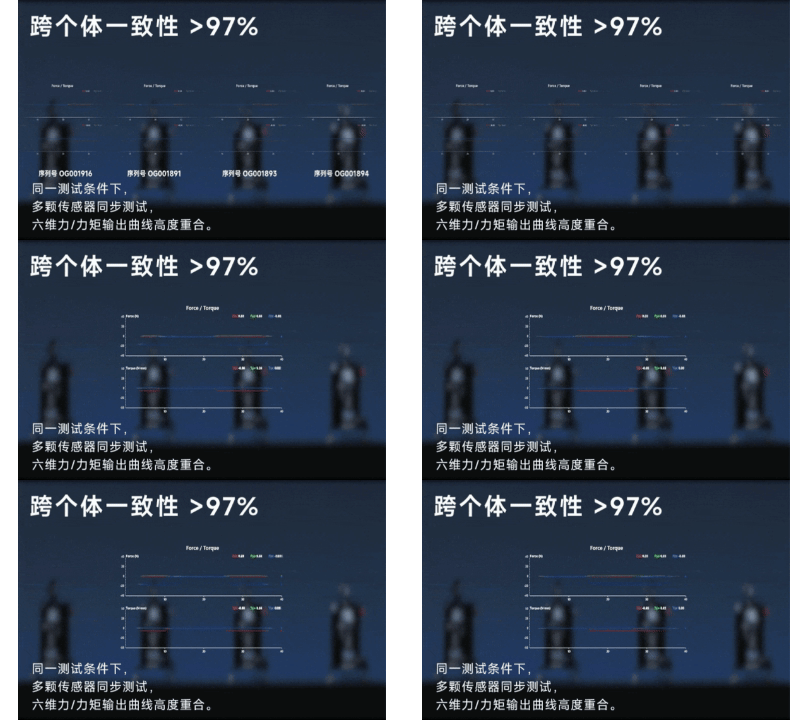
Xense sensor inter-unit consistency test
Spatial and temporal consistency across modalities is a prerequisite for a model to learn causal relationships between action and contact. Manipulation learning must match visual frames and motion trajectories with tactile changes. If tactile signals, actions, and images are misaligned in frame rate or timestamps, the model struggles to learn the interaction accurately. Xense applies multimodal collection standards that strictly align visual, tactile, and action signals. Real-time monitoring and playback help researchers check quality during collection and review examples before training.

Real-time monitoring and playback in Xense's XTac UMI multimodal collection system
Physical consistency in data representation determines whether tactile signals accurately reconstruct the mechanics of contact. Recorded signals must correspond to contact deformation and changes in force, with a consistent physical representation across real-robot collection and simulation-based training. Through tactile simulation and model research, Xense continually checks that its recorded contact information follows real physical laws.
When inter-unit, spatial and temporal, and physical consistency are all maintained, complete tactile signals can become training examples that models can use directly, providing foundational data for embodied-model research and evaluation.
The open-source release of MWA™-Phoenix creates an opportunity to reproduce and discuss motion–tactile learning and interaction prediction. For Xense, use by a frontier research team also provides valuable product-development feedback: which contact information should be preserved, what data are easiest to train on, and how sensing should adapt to particular tasks.
Xense will continue improving its tactile products and data foundation, using high-quality real tactile data to advance robotic manipulation.